栈
基本定义
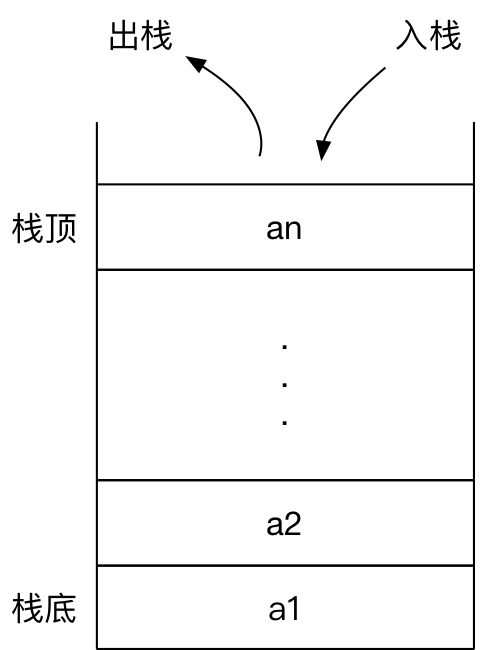
栈是一种特殊的线性表,插入和删除操作只能在一端进行操作。插入操作称为入栈(push),删除元素称为出栈(pop)。栈中没有元素称为空栈。栈的操作只能在一端进行,则最先入栈的元素将最后删除,因此栈也称为先进后出的线性表。
栈的基本操作
- push(e),入栈操作
- pop(),出栈操作
- peek(),获取栈顶元素
- isEmpty(),栈是否为空
示例代码如下
数组实现
1
2
3
4
5
6
7
8
9
10
11
12
13
14
15
16
17
18
19
20
21
22
23
24
25
26
27
28
29
30
31
32
33
34
35
36
37
38
39
40
41
42
43
44
45
46
47
48
49
50
51
52
53
54
55
56
57
58
59
60
61
62
63
64
65
66
67
68
69
70
71
72
73
74
```
public class StackWithArray {
    private int[] array;  //数组实现
    private int top = -1;  //初始化,栈空
    private int capacity; //栈的大小

    public StackWithArray(int capacity) {
        this.capacity = capacity;
        this.array = new int[capacity];
    }

    /**
     * 入栈
     *
     * @param value
     * @throws Exception
     */
    public void push(int value) throws Exception {
        if (top == capacity - 1) {
            throw new Exception("栈已满");
        }
        top++;
        array[top] = value;
    }

    /**
     * 出栈
     *
     * @return
     * @throws Exception
     */
    public int pop() throws Exception {
        if (top == -1) {
            throw new Exception("栈为空");
        }
        int value = array[top];
        top--;
        return value;
    }

    /**
     * 判断栈是否为空
     *
     * @return
     */
    public boolean isEmpty() {
        return top == -1;
    }

    /**
     * 获取栈顶元素
     *
     * @return
     * @throws Exception
     */
    public int peek() throws Exception {
        if (top == -1) {
            throw new Exception("栈为空");
        }
        return array[top];
    }

    public static void main(String[] args) throws Exception {
        StackWithArray stack = new StackWithArray(5);
        stack.push(1);
        stack.push(2);
        stack.push(3);
        System.out.println(stack.peek());
        System.out.println(stack.pop());
        System.out.println(stack.peek());
        System.out.println(stack.isEmpty());
    }
}
```
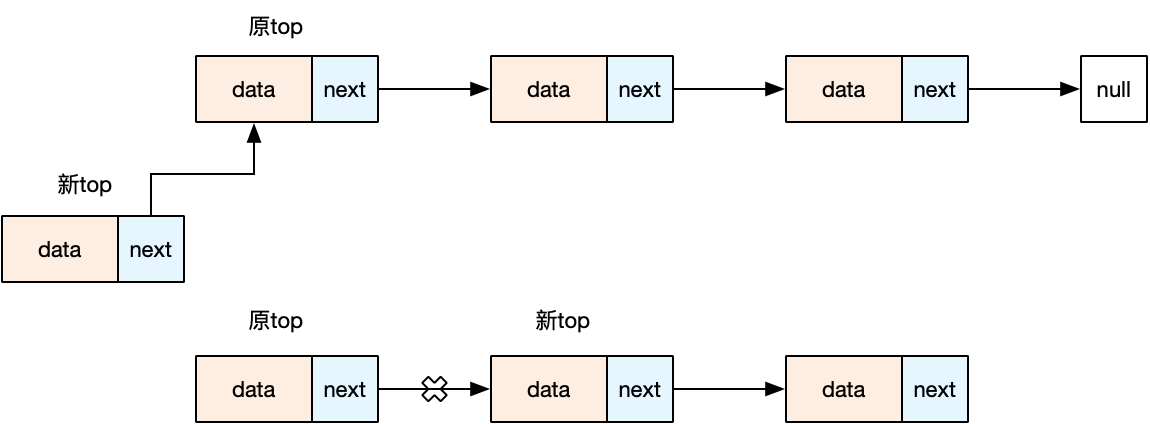
链表实现
1
2
3
4
5
6
7
8
9
10
11
12
13
14
15
16
17
18
19
20
21
22
23
24
25
26
27
28
29
30
31
32
33
34
35
36
37
38
39
40
41
42
43
44
45
46
47
48
49
50
51
52
53
54
55
56
57
58
59
60
61
62
63
64
65
66
```
public class StackWithLinkedList {
    public class Node {
        int data;  //关键字
        Node next; //尾指针,指向后继元素

        public Node(int data) {
            this.data = data;
        }
    }

    public Node top = null;
    public int size = 0;

    /**
     * 在头部插入
     *
     * @param data
     */
    public void push(int data) {
        Node node = new Node(data);
        node.next = top;
        top = node;
        size += 1;
    }

    public int pop() throws Exception {
        if (top == null) {
            throw new Exception("栈为空");
        }
        size -= 1;
        int data = top.data;
        top = top.next;
        return data;
    }

    /**
     * 获取栈的大小
     *
     * @return
     */
    public int getSize() {
        return size;
    }

    public boolean isEmpty() {
        return top == null;
    }

    public int peek() throws Exception {
        if (top == null) {
            throw new Exception("栈为空");
        }
        return top.data;
    }

    public static void main(String[] args) throws Exception {
        StackWithLinkedList stack = new StackWithLinkedList();
        stack.push(1);
        stack.push(2);
        stack.push(3);
        System.out.println(stack.peek());
        System.out.println(stack.isEmpty());
    }
}
```
常见用法
一个数组实现两个栈
将数组的起始位置看作是第一个栈的栈底,将数组的尾部看作第二个栈的栈底,压栈时,栈顶指针分别向中间移动,直到两栈顶指针相遇,则栈满。

1
2
3
4
5
6
7
8
9
10
11
12
13
14
15
16
17
18
19
20
21
22
23
24
25
26
27
28
29
30
31
32
33
34
35
36
37
38
39
40
41
42
43
44
45
46
47
48
49
50
51
52
53
54
55
56
57
58
59
60
61
62
63
64
65
66
67
68
69
70
71
72
73
74
75
76
77
78
79
80
81
82
83
84
85
86
87
88
89
90
91
92
93
94
95
96
97
98
99
100
101
```
public class TwoStacksFormAnArray {
    private int[] array;
    private int top1, top2;  //两个栈的栈顶
    private int capacity;

    public TwoStacksFormAnArray(int capacity) {
        this.capacity = capacity;
        this.array = new int[capacity];
        this.top1 = -1;  //栈1为空
        this.top2 = capacity;
    }

    public boolean stackEmpty1() {
        if (top1 == -1)
            return true;
        else
            return false;
    }

    public boolean stackEmpty2() {
        if (top2 == capacity)
            return true;
        else
            return false;
    }

    public int pop1() throws Exception {
        if (stackEmpty1())
            throw new Exception("栈1为空!");
        else {
            int value = array[top1];
            top1 -= 1;
            return value;
        }
    }

    public int pop2() throws Exception {
        if (stackEmpty2())
            throw new Exception("栈2为空!");
        else {
            int value = array[top2];
            top2 += 1;
            return value;  //索引变化
        }
    }

    public void push1(int x) throws Exception {
        if (top1 == top2 - 1)
            throw new Exception("发生上溢!");
        else {
            top1 += 1;
            array[top1] = x;
        }
    }

    public void push2(int x) throws Exception {
        if (top1 == top2 - 1)
            throw new Exception("发生上溢!");
        else {
            top2 -= 1;
            array[top2] = x;
        }
    }

    public int peek1() throws Exception {
        if (stackEmpty1())
            throw new Exception("栈1为空!");
        else {
            return array[top1];
        }
    }

    public int peek2() throws Exception {
        if (stackEmpty2())
            throw new Exception("栈2为空!");
        else {
            return array[top2];
        }
    }

    public static void main(String[] args) {
        TwoStacksFormAnArray t = new TwoStacksFormAnArray(5);
        try {
            t.push1(1);
            t.push1(2);
            t.push2(3);
            t.push2(4);
            t.push2(5);
            System.out.println(t.peek1());
            System.out.println(t.peek2());
            //t.push1(6);
            System.out.println(t.pop1());
            System.out.println(t.pop1());
            System.out.println(t.stackEmpty1());
        } catch (Exception e) {
            e.printStackTrace();
        }
    }
}
```
两个栈实现一个队列
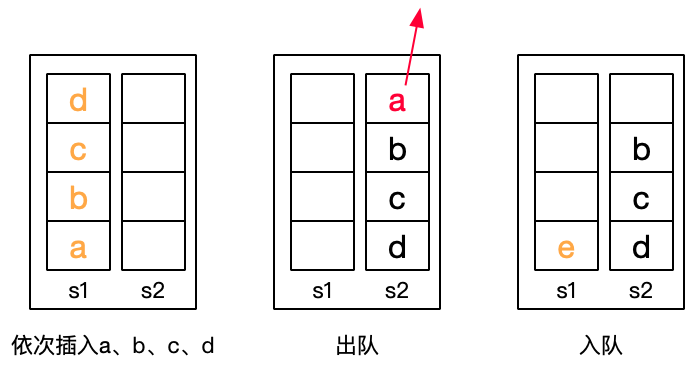
两种思路:
-
始终维护s1作为存储空间,以s2作为临时缓冲区。入队时,将元素压入s1。出队时,将s1的元素逐个“倒入”(弹出并压入)s2,将s2的顶元素弹出作为出队元素,之后再将s2剩下的元素逐个“倒回”s1。
-
入队时,将元素压入s1。出队时,判断s2是否为空,如不为空,则直接弹出顶元素;如为空,则将s1的元素逐个“倒入”s2,把最后一个元素弹出并出队。
1
2
3
4
5
6
7
8
9
10
11
12
13
14
15
16
17
18
19
20
21
22
23
24
25
26
27
28
29
30
31
32
33
34
35
36
37
38
39
40
41
42
43
44
45
46
47
48
49
50
51
52
53
```
public class TwoStacksFormAQueue {

    /**
     * 入队时,将元素压入s1。
     * 出队时,判断s2是否为空,如不为空,则直接弹出顶元素;
     * 如为空,则将s1的元素逐个“倒入”s2,把最后一个元素弹出并出队。
     */

    private Stack<Integer> s1;  //用来入栈,相当于队列的队尾
    private Stack<Integer> s2;  //用来出栈,相当于队列的队头

    public TwoStacksFormAQueue() {
        s1 = new Stack<>();
        s2 = new Stack<>();
    }

    public void addToTail(int x) throws Exception {
        s1.push(x);
    }

    public int deleteFromHead() throws Exception {
        if (s2.isEmpty() == true) {
            System.out.println("栈s2为空");
            stack1ToStack2();
        }
        return s2.pop();
    }

    public void stack1ToStack2() throws Exception {
        while (s1.isEmpty() == false) {
            s2.push(s1.pop());
        }
    }

    public static void main(String[] args) {
        TwoStacksFormAQueue queue = new TwoStacksFormAQueue();
        try {
            //queue.deleteFromHead(); //empty stack
            queue.addToTail(1);
            queue.addToTail(2);
            queue.addToTail(3);
            System.out.println(queue.deleteFromHead());
            System.out.println(queue.deleteFromHead());
            queue.addToTail(4);
            queue.addToTail(5);
            System.out.println(queue.deleteFromHead());
        } catch (Exception e) {
            e.printStackTrace();
        }
    }
}
```
队列
基本定义
队列是一种特殊的线性表,插入和删除操作在表的两端进行操作。插入操作称为入队(enqueue),删除操作称为出队(dequeue)。出队的一端称为队头,入队的一端称为队尾,因此队列的特点是先进先出。

队列的基本操作
- offer(e),入队操作
- poll(),出队操作
- isEmpty(),判断空队列
示例代码如下
循环队列
由于数组构成的队列容易造成空间的浪费,所以优化成循环队列。
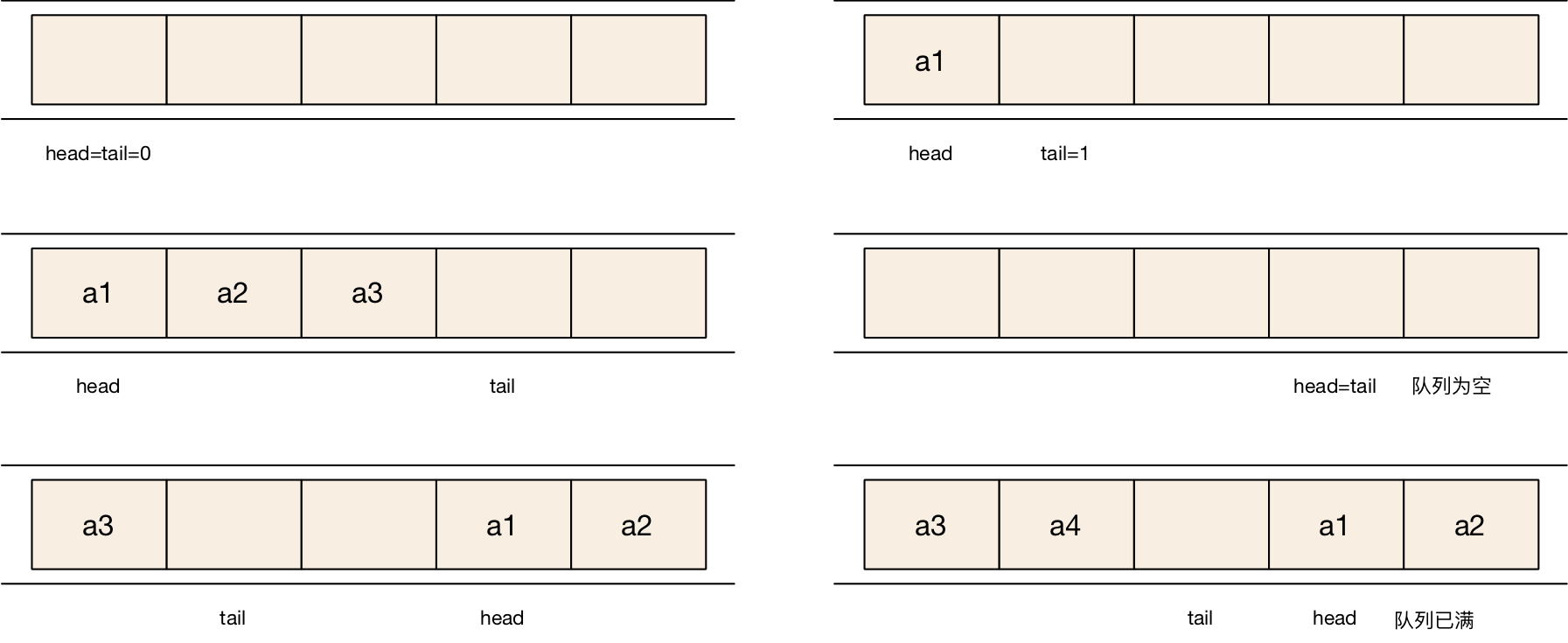
注意点:
为方便起见,初始化->head=tail=0
当队空:head=tail
当队满:head=tail(也成立)
但是这样就无法判断
处理:
- 另外设置一个标志位以区别队列是空还是满
- 少用一个元素空间,约定“队列头指针head在队尾指针tail的下一个位置上”,作为满状态
空:head=tail
满:(tail+1)%maxsize=head
1
2
3
4
5
6
7
8
9
10
11
12
13
14
15
16
17
18
19
20
21
22
23
24
25
26
27
28
29
30
31
32
33
34
35
36
37
38
39
40
41
42
43
44
45
46
47
48
49
50
51
52
53
54
55
56
57
58
59
60
61
62
63
64
65
66
67
68
69
70
71
72
73
74
75
76
```
public class CircularQueue {
    private int head = 0, tail = 0;  //设置队列的头指针和尾指针
    private int maxSize;  //队列的空间大小
    private int[] array;  //数组结构

    public CircularQueue(int maxSize) {
        this.array = new int[maxSize];
        this.maxSize = maxSize;
    }

    public boolean queueEmpty() {
        if (head == tail)
            return true;
        else

            return false;
    }

    public boolean queueFull() {
        if ((tail + 1) % maxSize == head)
            return true;
        else
            return false;
    }

    public void enqueue(int x) throws Exception {
        if (queueFull())
            throw new Exception("队列已满!");
        else {
            array[tail] = x;
            if (tail == maxSize - 1)
                tail = 0;
            else
                tail += 1;
        }
    }

    public int dequeue() throws Exception {
        if (queueEmpty())
            throw new Exception("队列为空!");
        else {
            int value = array[head];
            if (head == maxSize - 1)
                head = 0;
            else
                head += 1;
            return value;
        }
    }

    public static void main(String[] args) {
        CircularQueue queue = new CircularQueue(5);
        try {
            queue.enqueue(1);
            queue.enqueue(2);
            queue.enqueue(3);
            queue.enqueue(4);
            //queue.enqueue(5); //队列满
            System.out.println(queue.dequeue());
            System.out.println(queue.dequeue());
            queue.enqueue(5);
            queue.enqueue(6);
            //queue.enqueue(7);
            System.out.println(queue.dequeue());
            System.out.println(queue.dequeue());
            System.out.println(queue.dequeue());
            System.out.println(queue.dequeue());
            //System.out.println(queue.dequeue()); //队列空

        } catch (Exception e) {
            e.printStackTrace();
        }
    }
}
```
常见用法
两个队列实现一个栈
思路:
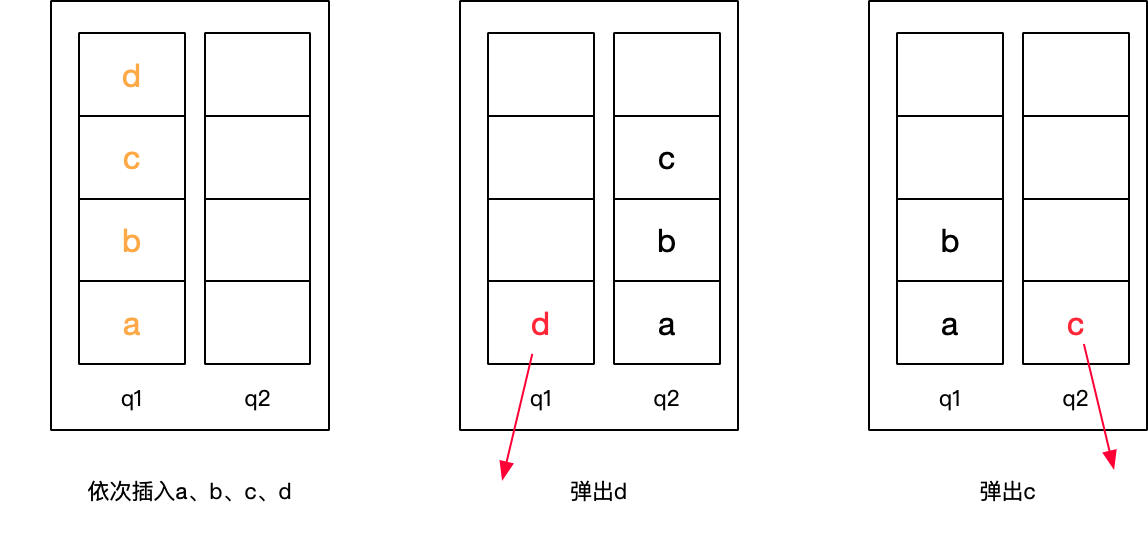
所有元素进入q1,因为我们的目的是栈,也就是最先出d,队列是从队头开始出,所有先把abc出q1并入q2,此时目标d跑到了队头,出q1。此时q1已经为空,下一个要出的是c,把ab从q2出队并进q1,此时目标c在q2队头,出队……..
即:把非空队列的n-1个压人空对列,剩的第n个出队…总有一个队列为空。
1
2
3
4
5
6
7
8
9
10
11
12
13
14
15
16
17
18
19
20
21
22
23
24
25
26
27
28
29
30
31
32
33
34
35
36
37
38
39
```
public class TwoQueuesFormAStack {
    private Queue<Integer> q1;
    private Queue<Integer> q2;

    public TwoQueuesFormAStack() {
        q1 = new LinkedList<>();
        q2 = new LinkedList<>();
    }

    public void push(int x) {
        q1.offer(x);
    }

    public int pop() {
        int value = 0;
        if (q1.isEmpty()) {
            while (q2.size() > 1) {
                q1.offer(q2.poll());
            }
            value = q2.poll();
        } else if (q2.isEmpty()) {
            while (q1.size() > 1) {
                q2.offer(q1.poll());
            }
            value = q1.poll();
        }
        return value;
    }

    public static void main(String[] args) {
        TwoQueuesFormAStack stack = new TwoQueuesFormAStack();
        stack.push(1);
        stack.push(2);
        System.out.println(stack.pop());
        System.out.println(stack.pop());
    }
}
```